Journal
Is a nose job in Korea worth the flight? A decision framework
Five questions that settle whether a nose job in Korea is worth the flight, using one model's front and side views.
 Megan Fairchild
People who ask whether a nose job in Korea is worth the flight are usually asking several smaller questions at once. Is the result I want achievable? Can I be away long enough? Who looks after me afterwards? I have arranged those into five questions, and I will use one model throughout.
Our model has a short, straight nose with a soft, rounded tip, set in a broad face with wide cheekbones. It is a useful example because the changes she might consider are refinements, and refinements are where the planning matters most. Each question below can be answered before you search for a single clinic.
Question one: can you describe the shape you want?
The first question has nothing to do with geography. If you cannot say what you would change, the flight cannot answer it for you. A surgeon anywhere will ask you to point at the bridge, the tip, the width or the angle to the lip. A destination does not replace that sentence.
Our model’s bridge is low and straight, and the tip is soft and slightly broad. A reasonable goal would be a little more definition at the tip while keeping the straight line and the nostril shape. That sentence is specific enough to carry into any consultation, in Seoul or at home.
If this is the size of change you want, the answer to the flight question depends mostly on logistics rather than on technique, because refinements of this kind are offered widely.
Questions two and three: fit and time
The second question is whether the clinic has experience with your type of nose and skin. Korea has a very large volume of rhinoplasty, and many clinics show a clear aesthetic: a straight, softly rotated nose with a refined tip. If that matches your goal, the experience is relevant. If you want to keep a strong or distinctive profile, ask to see work on noses similar to yours.
The third question is time. A nose job is not a weekend. Splints and tape usually stay on for around a week, and swelling continues to settle for many months. Most clinics will tell you the earliest day you can fly home. Ask for it in writing, and then ask what happens if the date moves.
Here is a front view as a reminder that the face matters as much as the nose. Our model has a wide face and broad cheekbones, and a slightly narrower bridge would change how the centre of the face reads.
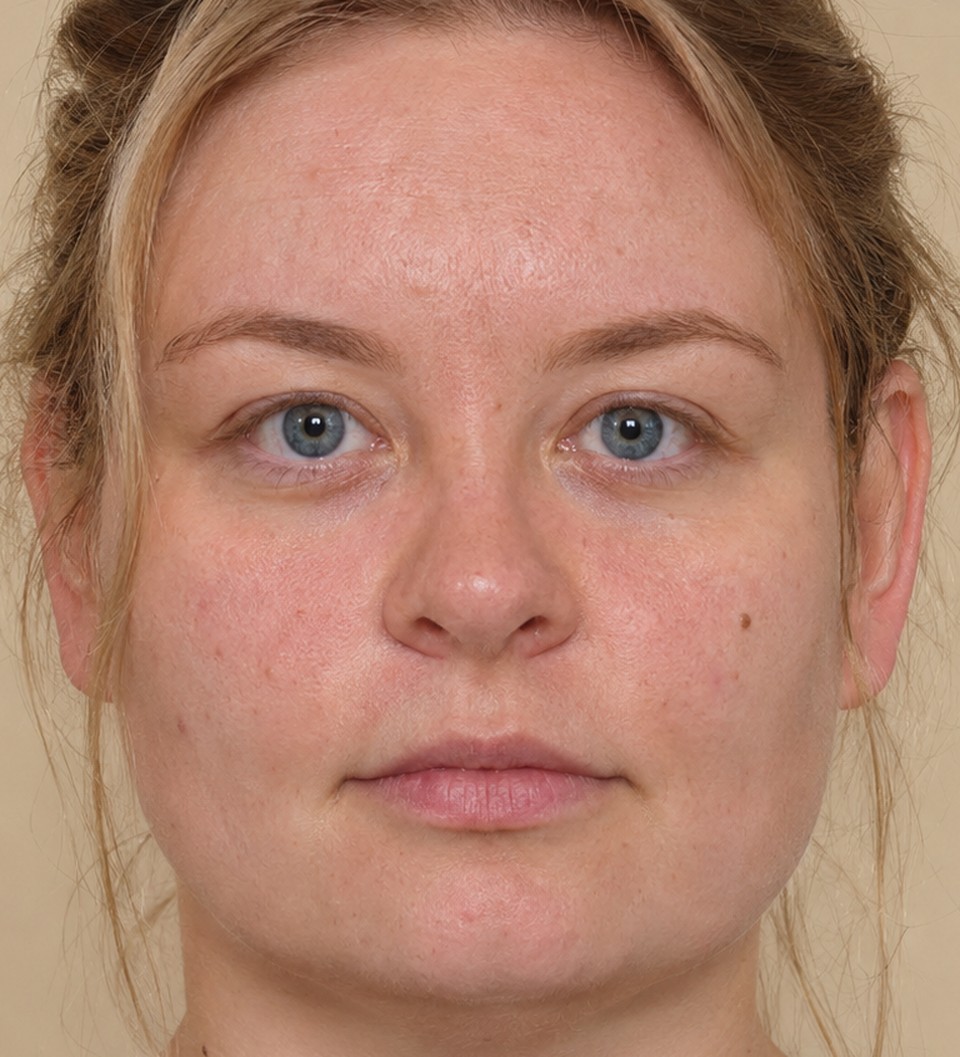
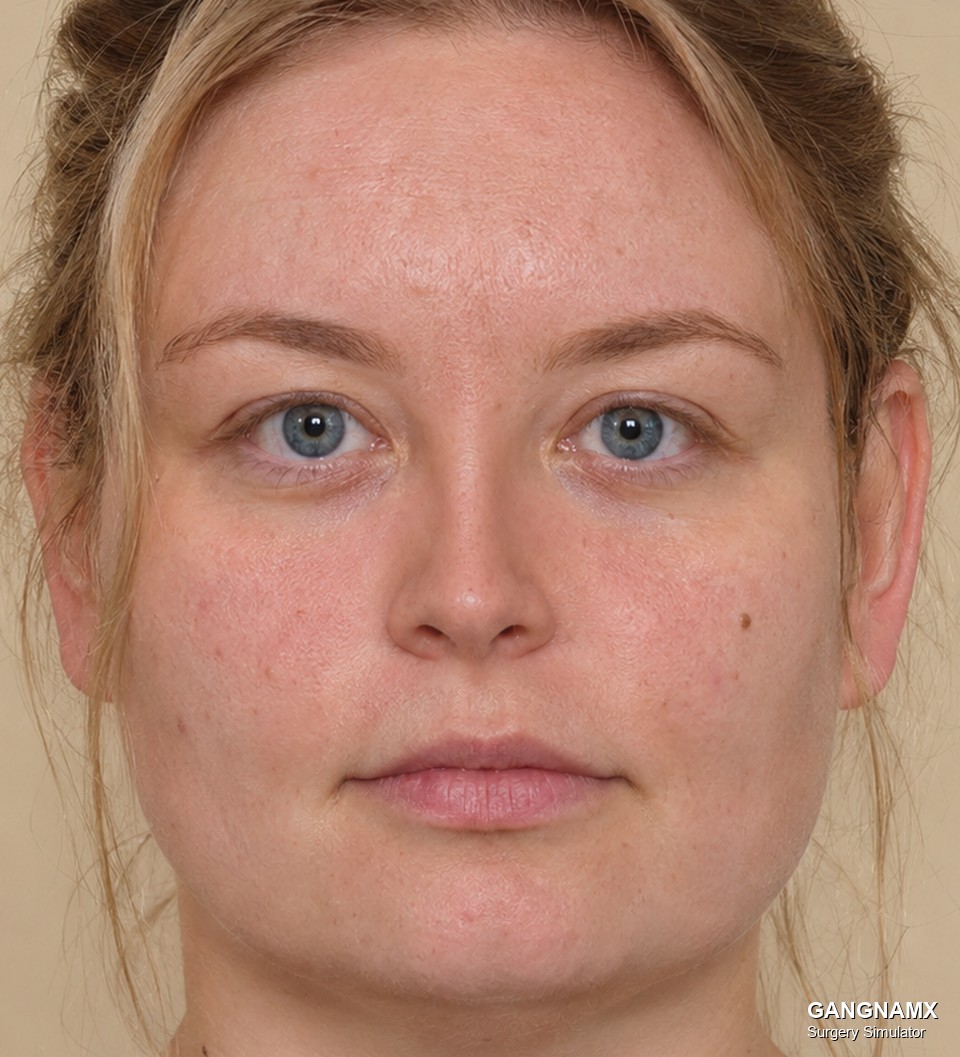
Seen from the front, the change is visible and still natural. The bridge is a little narrower and the tip more defined, so the nose sits more quietly in the face, and the eyes and mouth are untouched. Showing a picture like this to a surgeon makes the conversation concrete, and it makes it easier to judge whether their plan matches yours.
Questions four and five: afterwards, and the alternative
The fourth question is who looks after you when you are home. Swelling, a small asymmetry or a worry at week three will not wait for your next trip. Ask how follow up works from abroad, which photos the clinic wants, whether a local surgeon will see you, and how revisions are handled. A clear plan matters more than a promise.
The fifth question is the honest alternative. Would a surgeon near you deliver the same shape? For subtle refinements, often yes. For a larger change in bridge or tip, the Korean experience may be a real advantage, but only if you can accept the travel, the time away and the distance from your surgeon later.
A simple way to hold the five questions together is to answer them in order and write one line for each. If you can complete the first line and the others raise no alarm, the flight is a logistical choice. If the first line stays blank, the flight is premature.
Some readers like to turn the five questions into a short note before any consultation. It can be as plain as this:
- The shape I want, in one sentence, with a side photo.
- The clinic work that resembles my nose and skin.
- The earliest flight home, in writing.
- The follow up plan once I am back.
- The local option, and how it differs.
The note is not a commitment. It is a way of noticing which answer is still missing, and that is usually the one to settle first.
A question many readers skip: what would change your mind?
Before you commit, write down the one fact that would make you cancel the trip. It might be a follow up plan that depends on you travelling back, a surgeon who will not show a plan on your own photograph, or a timeline that leaves no room for swelling that settles slowly. Naming it in advance keeps the decision honest.
The reverse is useful too. Write down the fact that would make you more confident. For our model, a surgeon who looked at her side view and proposed only a small tip refinement would be a good sign, because it matches the modest change she described. A plan far larger than the goal would be a reason to pause.
This habit works because the flight creates its own momentum. Once a date is booked and a deposit paid, it becomes harder to say that the plan does not fit. A short list of conditions, written while you are still calm, gives you permission to stop. It also gives the clinic something specific to answer, and a good clinic will answer it plainly.
Closing observation
A good decision here is rarely about the flight. It is about whether the shape is clear, the plan is specific and the aftercare is realistic. Our model’s example shows how clear a refined change can look while the face stays hers, and how much easier it is to discuss when the picture exists before the appointment.
Seeing your own profile with a realistic refinement is a practical first step. Bring that picture to a consultation as a starting point for questions, not as an order, and let the clinician explain what is achievable on your nose.
Simulation images by GangnamX.
 Plastic Surgery SimulatorDecide with your own face.Open GangnamX