Journal
Why do I hate my side profile when my front looks fine?
What the 90 degree view shows that the front hides, explained with one model's front and side photos.
 Megan Fairchild
Many people feel at ease with their front view and uncomfortable with their side. The reason is simple: the front is a flat map of width, and the side is a map of depth. Projection, angles and lines that the front never records show up at ninety degrees, and the face you know suddenly looks unfamiliar.
Our model is a good illustration. In the front view she has a long face, hazel eyes and a calm expression. Nothing in that photograph would suggest that the profile has any particular feature to discuss. The side photograph is where the nose, the lips and the chin enter the conversation.
Reading a profile in four lines
A profile can be read with four lines, and none of them needs a tool. The first runs from the forehead down to the bridge of the nose. The second is the line of the nose itself, from the root to the tip. The third is the angle between the nose and the upper lip. The fourth is the line from the lips to the chin.
In the original side view, our model has a nose that projects clearly, with a tip that points slightly downward. The lips sit softly behind it, and the chin continues the line without a strong forward step. Seen together, the nose carries most of the visual weight of the profile.
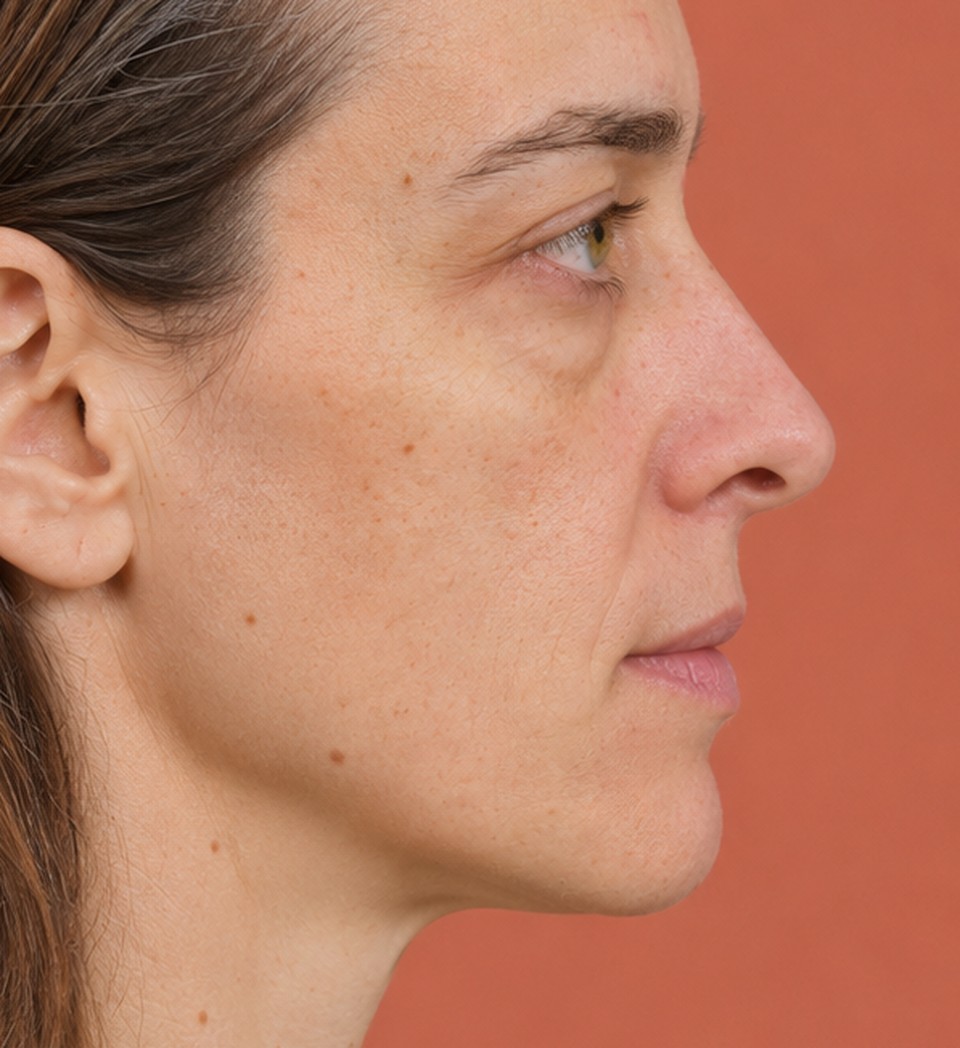
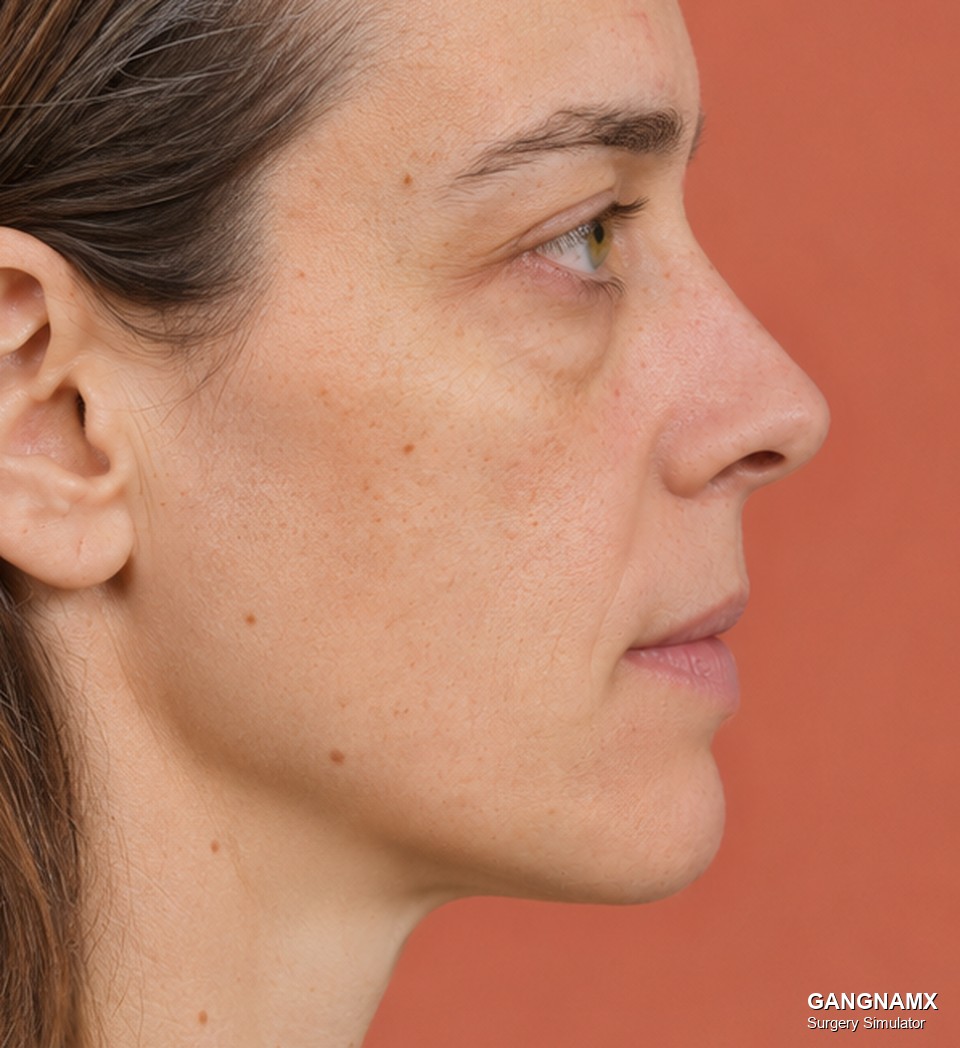
In the simulated view the change is easy to see. The bump along the bridge is gone, the nose is shorter, the tip lifts and the angle beneath the nose opens, so the profile reads as lighter. The chin and the lips are exactly where they were. That is a useful reminder that one line can change the impression of the whole side.
Why the side can feel worse than it is
There are ordinary reasons that the side view feels harder to accept, and they are not about the face at all. We see our own profile far less often than our front. A mirror shows only the front, and a phone held at arm length turns the face into a wider, closer version of itself.
A second reason is that side photographs are usually taken in poor conditions. The camera is too low, the chin lifts, the hair is pulled back, and the light comes from above. Each of these changes the line of the nose and the chin. A fair comparison needs a level camera at eye height and a relaxed jaw.
A third reason is contrast. The front view is symmetrical, so it appears balanced. The side view has no mirror image, so any strong line can look like a flaw. A pronounced nose or a soft chin is usually just a feature, and it only becomes a concern if it bothers you in photographs you take on your own terms.
A fourth reason is that a profile moves. When we speak or smile, the tip of the nose and the lips shift, and the side photograph freezes one moment of that. A single still may catch the least flattering one. Taking several photographs on different days gives a fairer picture of the line you actually have.
How small the change can be
If the side view is what troubles you, it helps to know how little may need to change. A few millimetres at the tip, or a small shift in the chin, can alter the character of the whole profile. This is why consultations usually start with the side photograph.
Our model’s front view shows what stays constant. The eyes, the brows and the width of the face are the same, and the person is plainly the same. A nose refinement like this leaves the face recognisable, which is often the first thing readers want to know.


From the front the nose looks narrower and more refined at the tip, and the nostril shape is more defined, yet the face is plainly the same. A change that is large in profile is quieter in the front view, which is one reason the front looks fine to you while the side does not. The two views describe the same nose in different languages.
A practical routine is to take three photographs: front, left side and right side, at eye height, with a neutral face. Place them next to each other and note which single line you would change. Most people name only one, and it is usually the nose or the chin.
If the answer is the chin, the same method applies. Look at where the lower lip sits compared with the chin point, and whether the line from the lips to the chin feels full or short. Naming the line, rather than the whole profile, is what makes the discussion with a clinician specific.
Closing observation
Disliking a side profile is common, and it is rarely a verdict on the face. It is a response to a view you see less often, in a form that is unforgiving. Naming the one line that bothers you turns a vague feeling into something that can be discussed.
I would suggest looking at your profile with a realistic change applied before deciding anything. Seeing the same face from the side, with one line adjusted, shows whether the discomfort is about the nose, the chin or simply the angle.
Simulation images by GangnamX.
 Plastic Surgery SimulatorDecide with your own face.Open GangnamX