Journal
Will your children inherit your old nose? Genes, surgery and the plain answer
Genes, surgery and the plain answer to whether children inherit your old nose, shown with one model's side view.
 Megan Fairchild
The short answer is that children inherit the genes you were born with, not the changes surgery made later. If you have a nose job, your own cells carry the same genetic instructions as before. A child will receive a mix of those instructions, so the nose they develop may resemble your original one.
That is not a promise about any particular child. Nose shape is shared between parents in complicated ways, and a child can look more like the other parent, a grandparent or no one in particular. The honest summary is that surgery changes your nose and leaves the family pattern alone.
How nose shape is passed on
A nose is built from bone at the top and cartilage lower down, covered by skin of a certain thickness. Many genes influence each part: how wide the bridge is, how far the tip projects, how the nostrils curve, how thick the skin is. No single gene decides the whole shape, which is why siblings can differ.
Because of this, family resemblance in noses is common but not exact. A child may inherit the width of one parent and the tip of the other. The result can be an almost entirely new shape that still looks as if it belongs to the family.
This also explains why people sometimes say a child has their old nose even though they cannot be sure. When you see a feature you changed in the face of someone you love, you notice it. When the same feature belongs to a relative, you may not. Memory and pictures of your earlier face help to keep the comparison fair.
It is worth adding that family looks come from more than the nose. Eye spacing, the length of the face and the line of the cheekbones are shared too, and a nose that looks familiar in a child may be one part of that wider pattern.
One face, two noses
Our model has a small, softly upturned nose set in a wide face with high cheekbones. In the original side view, the tip points slightly upward and the bridge is short. These are family features in the way hair colour or a smile can be, and they are part of how she looks.
If she were considering a refinement, a reasonable simulation might rotate the tip slightly less and define the bridge a little. The change is clear, and it keeps the character of the face. It also shows what a child of this nose might or might not resemble: the original lines are a family pattern, and the simulated lines are an individual choice.
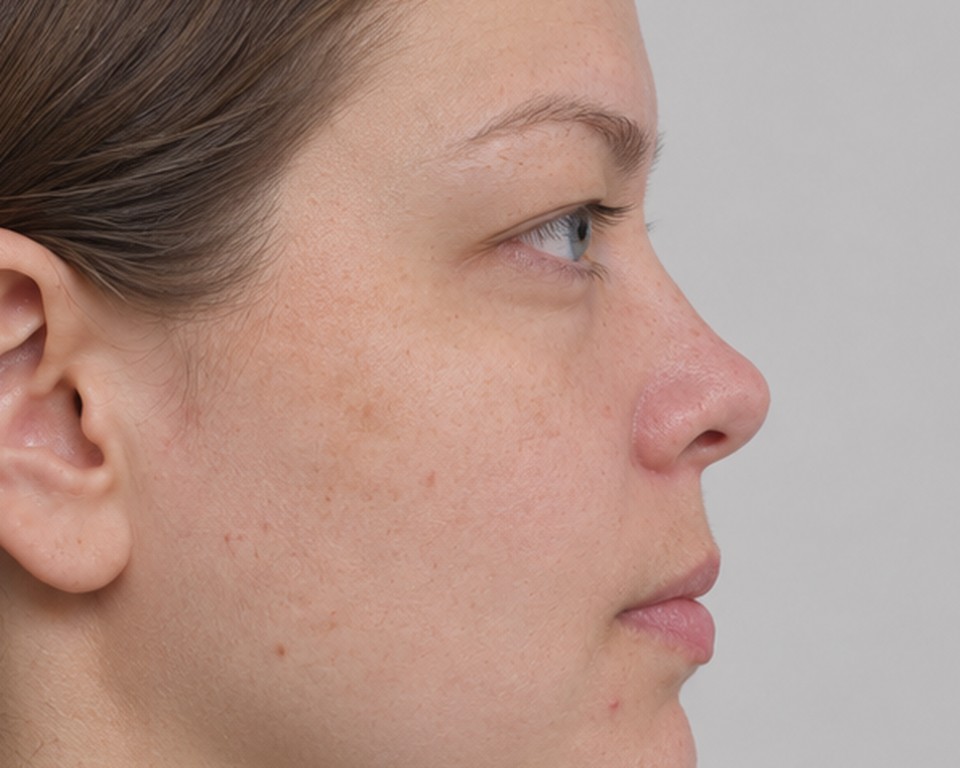
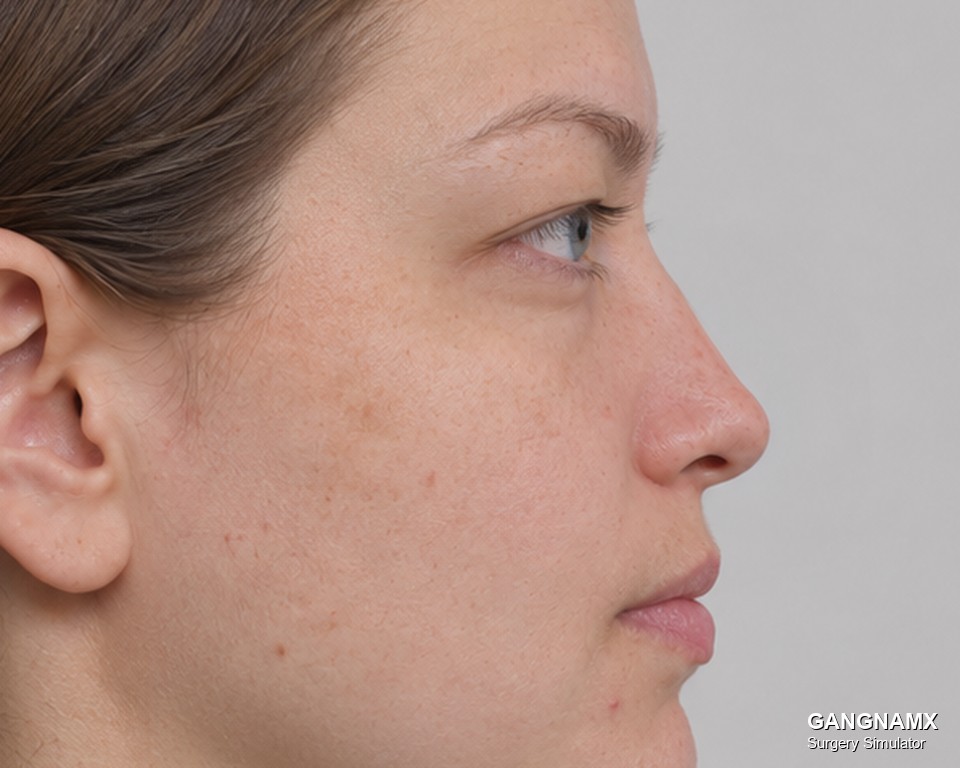
In the simulated side view the bridge is straighter, the tip is smaller and less upturned, and the nose sits closer to the face. The lips and chin are unchanged, so the overall profile still reads as hers. Nothing in this picture alters what she would pass on. It changes only what is visible on her own face.
A refinement of this kind leaves the rest of the face alone. The width of the face and the line of the cheekbones come from the family and stay as they are. Only the nose is adjusted.
What it means in practice
For most readers this question is really about identity. You may wonder whether a child will feel that you changed something that was theirs, or whether a child will wish for the nose you had. Neither is a medical matter, and both are best handled with ordinary honesty at home when the time comes.
Some people hesitate because a nose is a family feature, a link to a parent or grandparent. That is a sensible reason to refine rather than replace. A surgeon can keep the width, the angle or the character that you value, and change only what troubles you. Saying so at the consultation makes that possible.
It is also worth knowing that the question of timing is separate. Questions about surgery near pregnancy or in a child’s early years are for your own surgeon and doctor, and answers differ from person to person. A resemblance question can wait, because it does not change the decision about what suits your face.
A last point concerns the children themselves. A young person’s nose keeps growing into the teenage years, so a child who looks very like you at five may look different at fifteen. Judging inheritance early is unreliable, and it is a poor basis for any decision about your own face.
How can you tell what is family and what is just you?
One practical approach is to look at old photographs of your parents and grandparents from the side. Notice the bridge, the tip and the angle beneath the nose. If your original nose has the same line as a relative, it is likely a shared family feature. If it differs, it may come from a combination that is new.
This is less about predicting your children and more about understanding your own face. A feature that appears across several relatives is part of a pattern, and a surgeon can respect it when planning. A feature that appears only in you may be easier to adjust without changing the family look.
Our model’s small upturned tip and wide cheekbones could well be shared features, and that would be useful to know before any plan. If the cheekbones are the family signature, a refinement that leaves them alone keeps her recognisable to relatives. If the tip is the family signature, she may choose to keep more of it. Either choice is personal, and neither needs justification.
Closing observation
Surgery changes a nose, not a family. Genes set the pattern that children draw from, and nothing done to your nose rewrites it. What you can control is how your own face looks and how closely the result stays in line with who you are.
A helpful way to decide is to see the refinement on your own photograph first. If the picture still looks like you and the family resemblance is intact in your mind, you have learned something useful before any appointment.
Simulation images by GangnamX.
 Plastic Surgery SimulatorDecide with your own face.Open GangnamX